
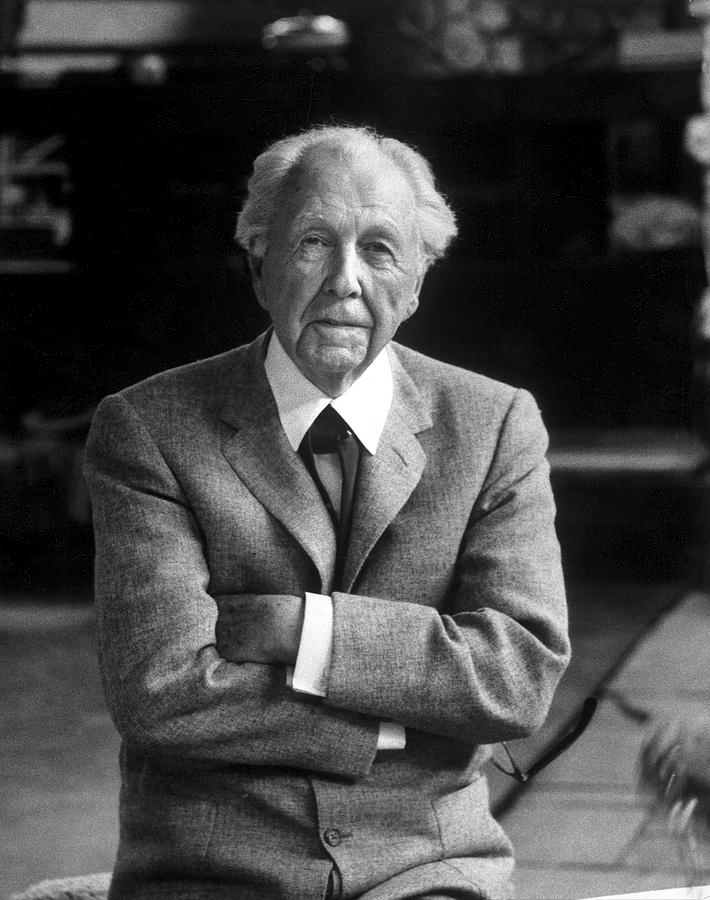
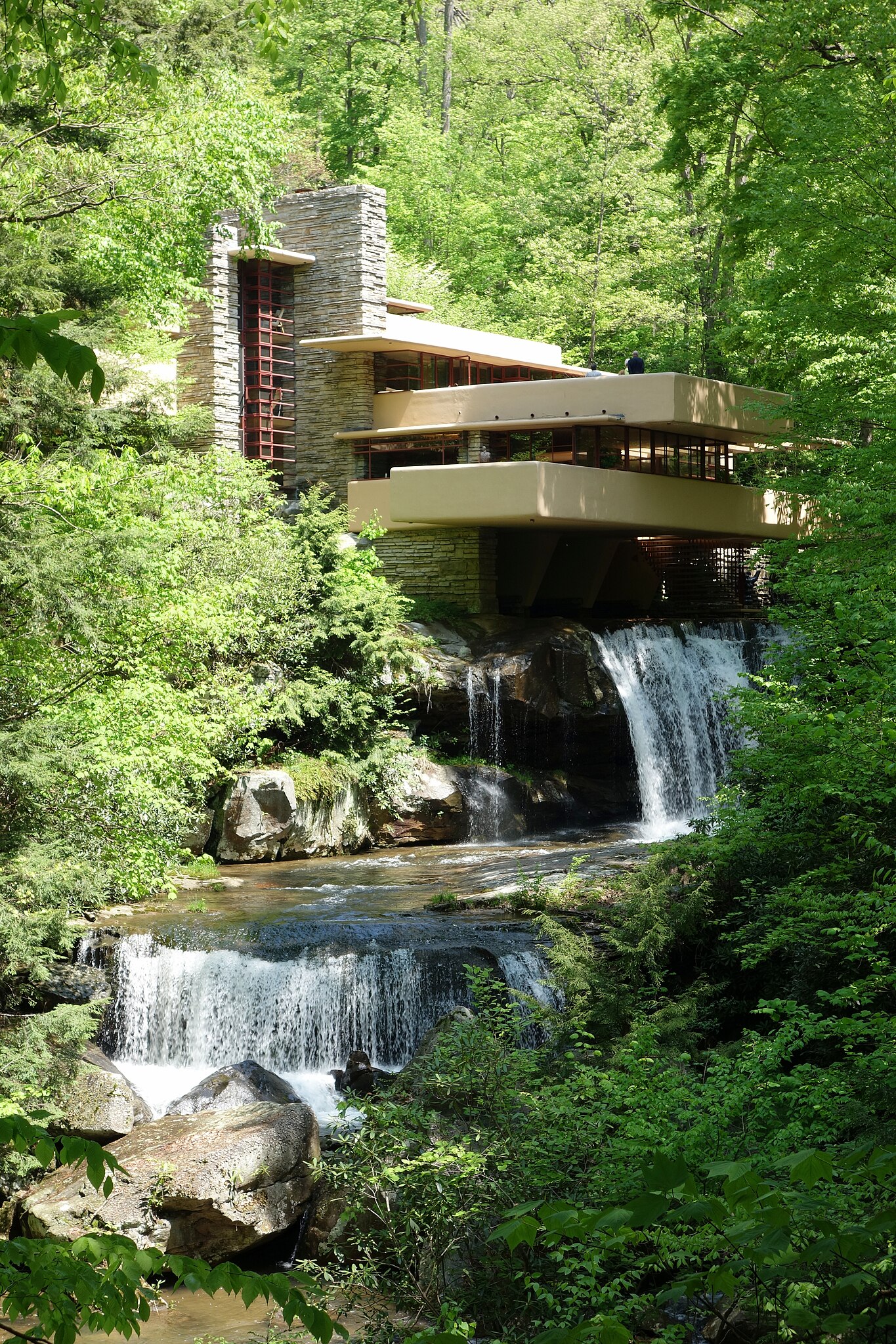
Left: Frank Lloyd Wright by Alfred Eisenstaedt // Right: Fallingwater by Gettty Images
Fallingwater – Where Concrete Meets the Creek
When Architecture Learns to Listen
Frank Lloyd Wright didn’t just design buildings—he choreographed them to dance with nature. And nowhere is that ballet more breathtaking than at Fallingwater, his 1935 masterpiece commissioned for the Kaufmann family (Kaufmann Department Stores) tucked into the woods of southwestern Pennsylvania.
Rather than placing the house beside the waterfall (as his client expected), Wright boldly cantilevered it over the falls. Because why settle for a view when you can live in the soundtrack? The result is a home that doesn’t just observe nature—it participates in it. Terraces jut out like rock ledges, the hearth is carved from the boulder beneath, and the sound of rushing water is a permanent houseguest.
Wright’s philosophy of “organic architecture” wasn’t just a poetic idea—it was a technical dare. He fused reinforced concrete with native stone, creating a structure that feels both futuristic and ancient. It’s as if the forest whispered its blueprint to him, and he listened.
Of course, Fallingwater also proves that Wright was part architect, part magician. He convinced the Kaufmanns that living above a waterfall wouldn’t be noisy—it would be meditative. (Spoiler: it’s both.) And while the cantilevers caused a few engineering headaches, the house still stands as a testament to Wright’s belief that architecture should grow from its site, not sit on top of it like a paperweight.
Fallingwater isn’t just a house—it’s an experience. If you ever find yourself in Pennsylvania, treat yourself to a tour. Walk the cantilevers, hear the waterfall, and feel what it’s like when architecture and nature speak the same language.
https://franklloydwright.org/site/fallingwater
At Meraki Architects, we admire Wright’s audacity and his reverence. Fallingwater reminds us that great design doesn’t conquer nature—it collaborates with it.