
Designing Beyond Boundaries
Inventor. Artist. Architect. Leonardo taught us to think in layers.
Long before the term “architect” implied licensure and liability, Leonardo da Vinci embodied its deeper meaning: master builder, visionary thinker, and relentless explorer of form and function.
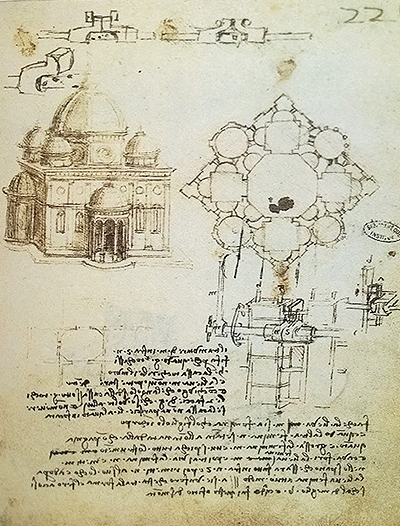
Though best known for his art, da Vinci’s architectural legacy is woven through his notebooks—pages brimming with sketches of ideal cities, fortifications, hydraulic systems, and structural innovations. He didn’t just draw buildings; he imagined how they breathed, moved, and served the people within them.
What made Leonardo extraordinary wasn’t just his technical skill—it was his curiosity. He studied anatomy to understand proportion, flight to grasp structure, and nature to decode systems. His designs were never isolated. They were part of a larger inquiry into how the world works and how humans live within it.
His concept for an “ideal city,” born in response to plague and overcrowding, proposed layered circulation, sanitation systems, and light-filled public spaces—centuries ahead of its time. It wasn’t just visionary. It was humane.
At Meraki Architects, we see da Vinci not just as a historical figure, but as a reminder that architecture is never one-dimensional. It’s art, science, empathy, and invention. It’s the willingness to ask “what if?” and the discipline to sketch the answer.
Leonardo’s legacy urges us to design with breadth—to merge disciplines, challenge norms, and root every line in care. He reminds us that the best architecture doesn’t just shelter—it inspires.
Because when design is driven by curiosity and soul, it transcends time.